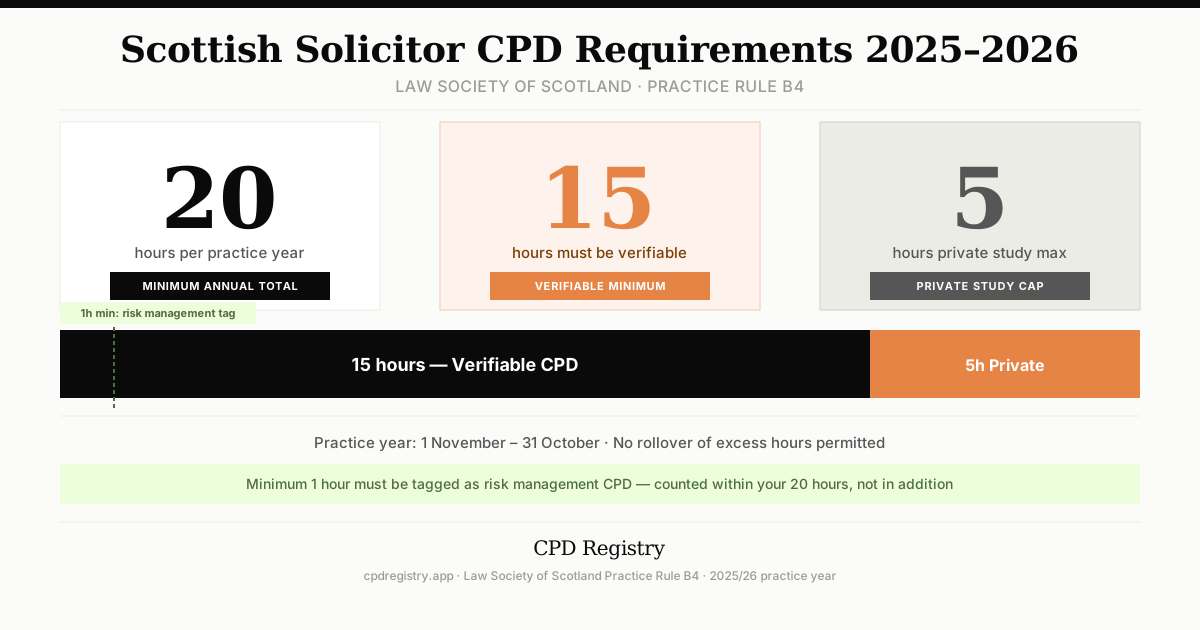
Every Scottish solicitor holding a practising certificate must complete 20 hours of CPD each practice year under Rule B4 of the Law Society of Scotland Practice Rules. The framework is specific: 15 hours must be verifiable, private study is capped at 5 hours, and a minimum of 1 hour must address risk management. The practice year runs from 1 November to 31 October. Hours don't roll over.
This guide covers everything you need to know about your CPD obligations as a Scottish solicitor in 2025/26, including what counts, how to record it, and what happens if the Law Society requests your records.
Key Takeaways
- 20 hours minimum per practice year (1 November – 31 October), per Law Society of Scotland Practice Rule B4. No rollover allowed.
- 15 hours must be verifiable CPD with clear aims, outcomes, and evidence.
- 5 hours maximum counts from private study. Hours above this cap are ignored.
- 1 hour minimum must be tagged as risk management CPD (counted within your 20).
- The Law Society can request your records at any time — contemporaneous logs protect your practising certificate.
Law Society of Scotland CPD Requirements at a Glance
| Requirement | Amount | Notes |
|---|---|---|
| Annual CPD total | 20 hours minimum | Required for all Scottish solicitors holding a practising certificate |
| Verifiable CPD | 15 hours minimum | Must include aims, outcomes, evidence, and interaction/feedback |
| Private study | 5 hours maximum | Self-directed reading, research, writing. Excess hours do not count |
| Risk management CPD | 1 hour minimum | Tag applied to any verifiable or private study entry. Not extra hours |
| Practice year | 1 November – 31 October | Different from calendar year. A 2025/26 year means Nov 2025 to Oct 2026 |
| Rollover | None | Hours exceeding the annual requirement are lost at year-end |
These requirements are set by the Law Society of Scotland under Practice Rule B4 and apply to all categories of Scottish solicitor, including in-house solicitors and those practising part-time.
What Does the 20-Hour Annual CPD Requirement Cover?
Scottish solicitors must complete a minimum of 20 CPD hours per practice year under Practice Rule B4 of the Law Society of Scotland. Of those 20 hours, at least 15 must be verifiable, no more than 5 can be private study, and at least 1 must be tagged as risk management. All three constraints operate simultaneously (Law Society of Scotland, Practice Rule B4).
The 20 hours aren't a suggestion or guideline. Rule B4 uses mandatory language. A solicitor who falls short without good reason may face regulatory action, including conditions on their practising certificate or referral to the Professional Conduct Committee.
What distinguishes the Scottish framework from other UK jurisdictions is the rigid split between two CPD categories and the additional risk management tagging requirement. A solicitor who completes 20 hours but only 12 are verifiable is non-compliant. A solicitor who completes 20 hours with no risk management tag is also non-compliant.
What Counts as Verifiable CPD for Scottish Solicitors?
Verifiable CPD is the backbone of the Scottish system — at least 15 hours per year, and realistically most solicitors exceed this as a matter of prudent practice. An activity qualifies as verifiable when it meets three conditions set by the Law Society of Scotland: it has defined aims and outcomes, includes evidence of participation, and involves some form of interaction or feedback.
What makes CPD "verifiable"? The Law Society of Scotland requires that the activity:
- Has defined aims and intended learning outcomes, stated in advance
- Includes evidence of participation, such as a certificate of attendance, confirmation email, or written assessment
- Involves some form of interaction, assessment, or feedback — you can't simply watch a recording and claim verifiable hours
Examples of verifiable CPD include:
- Accredited CPD courses and seminars (in-person or live online)
- Webinars with Q&A and a certificate of attendance
- Conferences with structured sessions and formal registration
- In-house training sessions led by senior practitioners with documented outcomes
- University short courses and postgraduate modules with assessment
- E-learning modules with testing and completion certificates
The key test is whether you can produce evidence that you engaged with the learning, not just that you were present. A certificate recording only attendance is weak evidence. A certificate recording attendance plus a stated learning outcome and confirmation of interaction or assessment is strong evidence.
How Much Private Study Can Count Toward Your Annual Total?
Private study covers self-directed learning: reading legal journals, textbooks, case law updates, regulatory guidance, and writing publications. Up to 5 hours count toward your 20-hour annual total. That cap is a ceiling, not a target.
If you record 7 hours of private study, only 5 count. The extra 2 hours are discarded for compliance purposes. A solicitor relying heavily on private study must still secure at least 15 hours of verifiable CPD to reach the 20-hour minimum.
Private study must still be recorded. The Law Society expects you to log what you read, for how long, and what you learned. This is less demanding than the verifiable CPD evidence requirements, but undocumented private study hours can't be defended at audit.
Risk Management CPD: The 1-Hour Minimum
Every practice year, Scottish solicitors must complete at least 1 hour of CPD tagged as risk management. This is a feature unique to the Scottish CPD framework — England and Wales don't have an equivalent mandatory risk management tagging requirement under the SRA. The Law Society of Scotland requires this tag on at least 1 hour of verifiable or private study CPD covering topics such as anti-money laundering, professional ethics, or data protection (Law Society of Scotland, Practice Rule B4, 2025).
The risk management tag categorises your training, not your hours bucket. A risk management hour counts simultaneously as verifiable or private study CPD. So if you complete a 2-hour verifiable course on anti-money laundering, both hours count toward your verifiable minimum, your 20-hour total, and your risk management requirement. You don't need 21 hours because of the risk management tag.
Acceptable risk management CPD topics include:
- Anti-money laundering (AML) obligations and suspicious activity reporting
- Professional ethics and conduct, including conflicts of interest and confidentiality
- Client care, complaints handling, and professional negligence
- Data protection, GDPR, and information security
- Financial compliance and the Solicitors' Accounts Rules
- Practice management, including file management and supervision of junior staff
The Law Society of Scotland views risk management as integral to professional competence. A solicitor who can't demonstrate any risk management CPD over a practice year may be asked to explain how they identify, assess, and mitigate the risks inherent in legal practice.
When Does the Scottish CPD Practice Year Run?
The Scottish CPD practice year runs from 1 November to 31 October — different from the calendar year and from the CPD years used in England and Wales and Northern Ireland. This boundary matters more than most solicitors expect, because a single day's difference determines which year an activity counts in.
An activity completed on 25 October 2025 counts toward the 2024/25 practice year. The same activity completed on 2 November 2025 counts toward the 2025/26 year. If you're close to the year boundary and have already met your requirement for the current year, recording an activity a week later can be advantageous — but only if you understand the boundary.
The practice year is typically displayed as a split year (2025/26) to avoid ambiguity. Your compliance report should clearly state which practice year it covers.
Can Scottish Solicitors Carry Unused CPD Hours Forward?
No. The Law Society of Scotland doesn't permit rollover of excess CPD hours from one practice year to the next. Every solicitor starts each practice year at zero, regardless of how many hours they completed previously. This is stricter than the Swedish Bar Association (Advokatsamfundet) framework, which allows up to 12 hours of rollover, and stricter than the more flexible approach available to solicitors under the SRA's outcomes-based model in England and Wales.
For Scottish solicitors, the rule is absolute: hours above 20 in one year disappear at the end of the practice year. They can't be carried forward, banked, or credited against the next year (Law Society of Scotland, Practice Rule B4).
The practical consequence is that you should track your hours against the correct year boundary with precision. A solicitor who defers recording several CPD activities until after 31 October may find those hours allocated to the new year, leaving the previous year short of the 20-hour requirement.
What Counts? Training Types for Scottish Solicitors
The Law Society of Scotland recognises a broad range of learning activities. What matters is that each activity is appropriate to your practice area and professional development needs.
Verifiable CPD Activities
Verifiable CPD must include clear aims and intended outcomes, evidence of participation, and some form of interaction or feedback. Activities that meet this standard include:
- Attending an accredited CPD course or seminar
- Participating in a live webinar with Q&A
- Completing a structured e-learning module with assessment
- Delivering CPD training or presenting at a conference (preparation time counts)
- Attending a conference or professional forum with structured sessions
- Completing a postgraduate module with formal assessment
Private Study Activities (Max 5 Hours)
- Reading legal journals, law reports, and regulatory updates
- Reading textbooks and practice manuals
- Researching a specific area of law for a case or transaction
- Writing articles, case notes, or legal commentary for publication
What Does Not Count
- Unstructured networking or social events at conferences
- Routine client meetings and file management
- Marketing and business development activities with no learning component
- Pro bono casework without a documented learning reflection
How to Record CPD and Stay Audit-Ready
A defensible CPD record captures more than hours. It captures evidence, reflection, and category tags — all of which the Law Society can request at any time.
Record Every Activity at the Time It Happens
Contemporaneous recording is the single most important habit. For every CPD activity, record:
| Field | What to Log |
|---|---|
| Date | When the activity took place |
| Activity | Name of the course, webinar, or activity |
| Provider | Who delivered it or "self-directed" for private study |
| Duration | Hours completed, rounded to the nearest half-hour |
| Category | Verifiable CPD or private study |
| Risk management | Yes or no (tag, not additional hours) |
| Reflection | One to three sentences: what you learned and how it applies |
| Evidence | Certificate file, confirmation email, or written notes |
The reflection field is what transforms a log into a defensible portfolio. A one-sentence note such as "This session clarified the 2025 amendments to the Proceeds of Crime Act reporting obligations. I'll update our firm's AML procedures to reflect the new threshold" is sufficient.
Store Evidence Alongside Records
Attach the certificate, confirmation email, or other evidence to each log entry. A certificate stored in a separate folder with no link to the corresponding record is difficult to reconcile at audit.
Review Your Progress Quarterly
A quarterly review takes five minutes: check your total hours, your verifiable-to-private-study split, and your risk management tag. If you're on track for 20 hours with 15 verifiable and 1 tagged as risk management, you're compliant. If any metric is behind, you have time to address it before the year ends.
Keep Records for Five Years
The Law Society of Scotland can request records retrospectively. Keep your full CPD log and supporting evidence for a minimum of five years.
What Happens During a Law Society of Scotland CPD Audit?
The Law Society of Scotland can request your CPD records at any time as part of its regulatory supervision. A complete audit response must show all CPD activities across the practice year, with dates, durations, verifiable and private study categories, risk management tags, and supporting evidence such as certificates (Law Society of Scotland Practice Rules, 2025).
The Law Society doesn't routinely audit every solicitor every year, but requests typically arise through:
- Random compliance spot-checks
- Investigation of a conduct complaint that raises competence questions
- Firm-wide regulatory visits
- Renewal of practising certificate where declarations trigger a review
When a request arrives, the Law Society will look for:
- Total hours meeting the 20-hour minimum
- At least 15 verifiable CPD hours with evidence
- No more than 5 private study hours counted toward the total
- At least 1 hour tagged as risk management
- Evidence of genuine reflection, not just attendance
- Activity spread across the year, not clustered in the final month
A reconstructed spreadsheet assembled the week before the request lacks the contemporaneous detail — dates, reflection notes, certificate attachments — that a maintained digital log provides. The difference between a record kept throughout the year and one assembled under pressure is visible to a reviewer.
How CPD Registry Works for Scottish Solicitors
CPD Registry loads the exact Law Society of Scotland CPD requirements for your jurisdiction — the 20-hour total, 15-hour verifiable minimum, 5-hour private study cap, and 1-hour risk management tag — and enforces them in real time as you log activities. You see your compliance status at a glance: total hours, verifiable hours, private study hours, and risk management tag status.
Every log entry captures the date, category, duration, provider, and a reflection note. Certificates attach directly to each entry. When you export a PDF report, it follows the Scottish practice year (2025/26) and formats everything the way the Law Society expects — UK date format, categories labelled as Verifiable CPD and Private Study, and a clear risk management status.
Explore the full feature set or start the 30-day free trial. No credit card required.
Frequently Asked Questions
How many CPD hours do Scottish solicitors need?
Scottish solicitors must complete a minimum of 20 hours of CPD each practice year (1 November to 31 October), as required by the Law Society of Scotland under Practice Rule B4. Of those 20 hours, at least 15 must be verifiable CPD. Private study hours are capped at a maximum of 5. An additional minimum of 1 hour must be tagged as risk management CPD (counted within your existing hours, not in addition to the 20).
What is the difference between verifiable CPD and private study?
Verifiable CPD (minimum 15 hours) must be structured learning with clear aims and outcomes, evidence of participation such as a certificate or email confirmation, and some form of interaction, assessment, or feedback. Private study (maximum 5 hours) covers self-directed learning such as reading legal journals, textbooks, case law, or writing publications. It must still be recorded but requires less formal evidence.
What counts as risk management CPD?
Risk management CPD covers topics that help solicitors identify and manage professional risks: anti-money laundering, professional ethics and conduct, client care and complaints handling, data protection, financial compliance and accounts rules, and practice management. You need at least 1 hour per year tagged as risk management. This is a tag applied to verifiable or private study entries, not a separate hours category.
What is the Scottish CPD practice year?
The Scottish CPD practice year runs from 1 November to 31 October each year. For example, the 2025/26 practice year covers 1 November 2025 to 31 October 2026. This differs from the calendar year and from other UK jurisdictions. The membership year is displayed as 2025/26 for clarity.
Can Scottish solicitors carry over excess CPD hours?
No. The Law Society of Scotland doesn't permit rollover of excess CPD hours from one practice year to the next. Every solicitor starts each practice year at zero. If you complete 25 hours in one year, the 5 excess hours can't be applied to the following year.
What happens during a Law Society of Scotland CPD audit?
The Law Society of Scotland can request your CPD records as part of its regulatory supervision. You'll need to produce a complete record showing all CPD activities across the practice year, with dates, durations, categories, risk management tagging, and evidence such as certificates. Contemporaneous records maintained throughout the year are far easier to produce than a reconstructed spreadsheet.
How should Scottish solicitors record CPD to comply with LSS rules?
For each CPD activity, record the date, activity name, provider, duration, category (verifiable or private study), risk management tag, and a brief reflection on what you learned. Store certificates against each entry. Review progress quarterly against the 20-hour target. A digital CPD tracker that enforces the Scotland-specific rules automatically removes the risk of year-end reconstruction.
Do Scottish solicitors have to do risk management CPD every year?
Yes. The Law Society of Scotland requires a minimum of 1 hour of risk management CPD every practice year. This has been a standing requirement and forms part of the profession-wide framework for solicitor competence. It isn't an additional hour beyond the 20-hour annual total.
Sources: Law Society of Scotland Practice Rules | Law Society of Scotland CPD Guidance | Law Society of Scotland, Rule B4 — Continuing Professional Development. Retrieved May 2026.
This guide reflects the Law Society of Scotland CPD requirements for the 2025/26 practice year. Last reviewed 27 May 2026.